
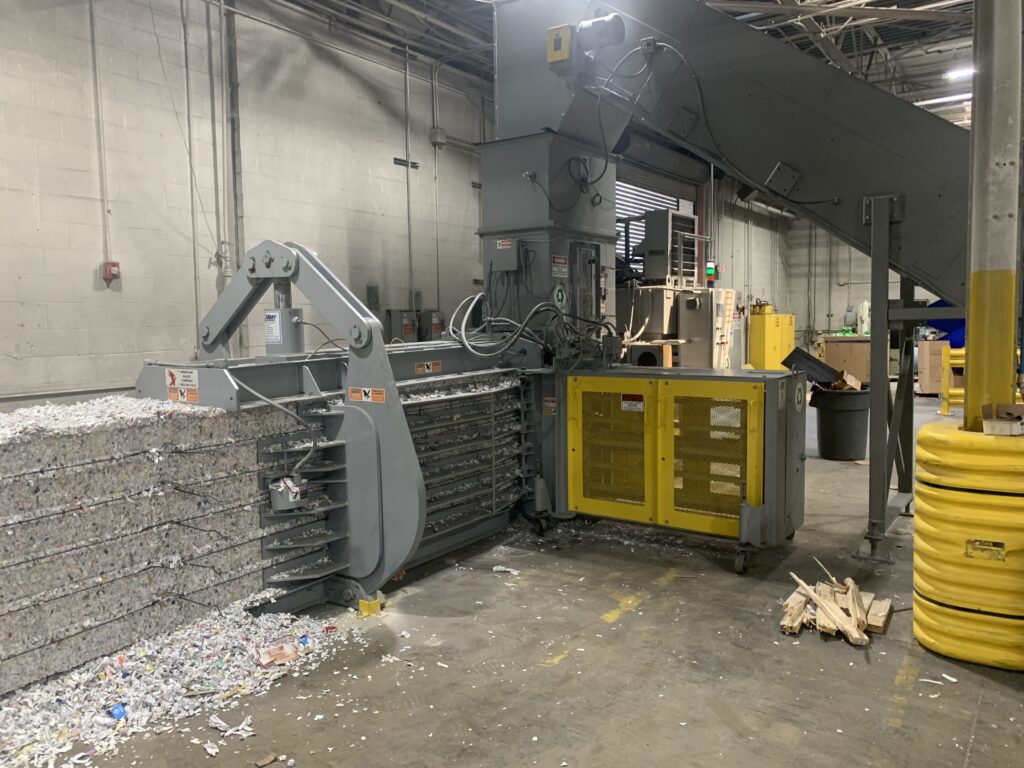
Secure destruction changed in one specific way this year. Buyers no longer accept shredding alone. They want documentation proving the destruction actually happened the way it should, and increasingly they want proof of what happened to the material afterward. Shredded paper that ends up in a landfill now counts as a failure, not a footnote, and providers now point to baling shredded paper and shipping it to certified recycling facilities as part of what they sell.
If you shred in house, that second half is where most programs are weak.
Plants shred more than people think. HR files, obsolete engineering drawings, batch records, misprinted labels carrying customer data, packaging with a brand mark your contract requires you to destroy. Compliance usually drives the security side, so that part lands early. Nobody looks at the handling side until the dumpster fills with confetti twice a week.
Shredded paper is one of the lowest density materials in your building. Loose shred is mostly air. You pay to haul air, and every pull is a pull you did not need. Baling shredded paper turns that same material into sorted office paper or mixed paper with an actual market value instead of a disposal cost.
Four things to check before you assume your setup handles it
Particle size
Smaller cross-cut output bales poorly and can bridge in the chamber. Know what your shredder actually produces before anyone sizes a baler around it.
Feed method
A shredder runs continuously. Hand loading gaylords into a vertical baler is a different job than a blower or conveyor feeding straight into a horizontal. Get this wrong and you buy labor you did not budget for.
Contamination
Binder clips, laminated covers, plastic sleeves, and window envelopes all downgrade the bale. Sort at the shredder, not at the baler.
Weight documentation
If you report diversion numbers, ask your mill or broker for scale tickets. Estimates will not survive an audit.
Size the shredder and the baler together
Treat them as one system, not two purchases. We see plants buy a good shredder, then discover six months later that nobody planned anything downstream of it. That is a fixable problem, but it costs less to fix on paper than on the floor.
Source: i-SIGMA/NAID 2026 annual conference coverage and industry trend reporting.