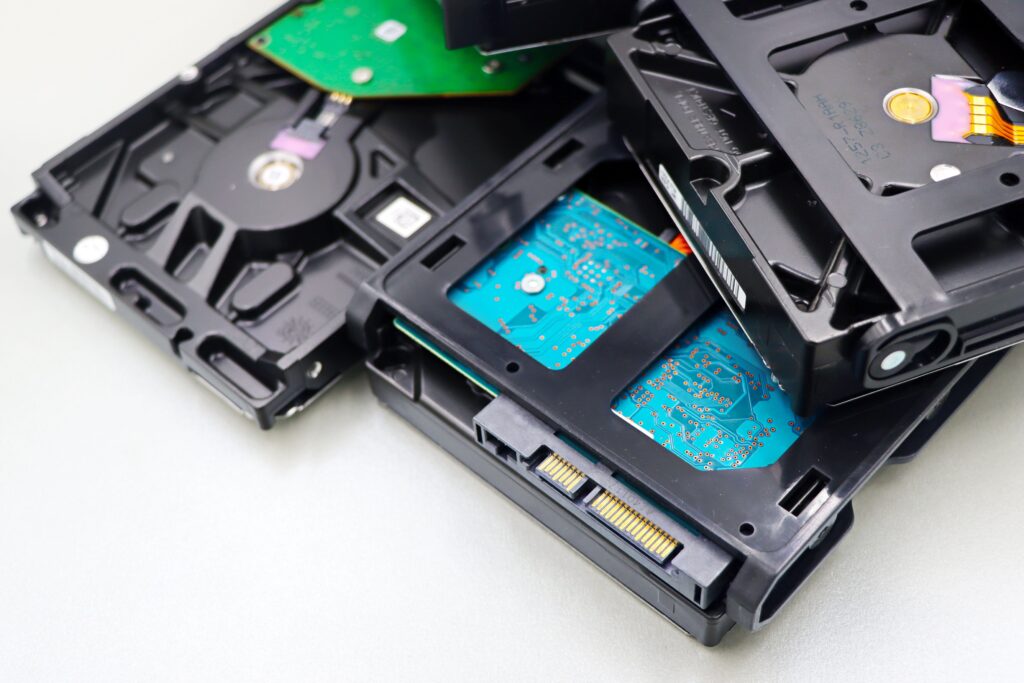
Walk through the back of almost any plant or distribution center and you will find it: a cage or a gaylord full of retired laptops, handheld scanners, old HMI panels and loose hard drives. Somebody pulled them out of service, nobody knew exactly what to do with them, and there they sit.
Every one of those devices may still hold data: customer orders, employee records, network passwords, process settings. A locked cage is storage, not destruction.
In September 2025, NIST published Revision 2 of SP 800-88. That’s the federal guideline most companies and auditors point to for wiping or destroying data storage. If you run operations, three changes are worth knowing.
Degaussing alone no longer counts as destroy. Rev. 2 says degaussing is not currently a destroy technique. If your process is “run it through the degausser and toss it,” that process needs a second step. Degaussers also do nothing to solid state drives, which is most of what’s inside newer laptops and scanners.
Particle size matters more than it used to. Modern drives pack data far more densely. A shredder that leaves large pieces may be fine for an older spinning hard drive but can leave SSD memory chips intact. Match the equipment to the media you actually throw out.
It’s a program, not a machine. NIST has moved toward expecting a written sanitization program and proof that the job was done. In practice, that means a log of what came in, what was destroyed, when, and by whom.
So what does that look like on a plant floor?
Start by counting. How many drives, phones, scanners and controllers do you retire in a year? A few dozen points to a compact crusher or a desk-side drive destroyer. Hundreds or thousands, or a corporate rule that media never leaves the site, justifies a dedicated e-waste shredder.
Next, decide whether destruction happens inside your fence or goes to a vendor. Outside services work, but the chain of custody leaves your building. Many plants already shred paper on site for the same reason.
Finally, think about what comes out the back. Shredded electronics are a recyclable stream. Steel, aluminum, copper and circuit board material all have buyers. Handled right, destruction helps your zero waste to landfill numbers instead of hurting them.
DeHart carries crushers, degaussers and e-waste shredders sized for anything from a single office to a full distribution campus. If that cage in the back is filling up, call us at (314) 292-8181 and we’ll help you size the right setup.
Source: NIST Special Publication 800-88 Revision 2, Guidelines for Media Sanitization (September 2025).